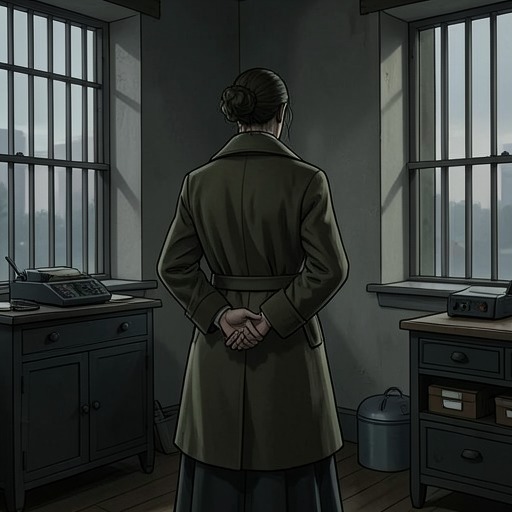
Smilla crosses the ice to Gela Alta
Smilla's Sense of SnowSmilla crosses the ice to Gela Alta in pursuit of the men who have gone ahead, and the crossing becomes the last test of her endurance before she reaches Tørk. The route offers no secure passage: the ice is too thin, the light fades, and the glacier’s smooth surface breaks into a maze. By the time she finds Tørk waiting alone, the chase has narrowed to a direct confrontation.
Waiting for the Ice
The pontoon bridge is still out when Smilla reaches the crossing. She understands at once that she has arrived too early: the ice is transparent and cannot bear her weight. Rather than risk stepping onto it, she sits on a chair and props her feet on the cable box, the same place where Jakkelsen and Hansen once sat. The ship’s repeated tracks become a measure of the way lives also circle back over familiar ground.
Snow falls in large flakes, qanik, like the snow on Isaiah’s grave, but the ice is still warm enough for each flake to melt. Smilla watches the snow as if it were rising from the sea rather than descending from the sky. She traces its long transformation: fresh six-sided flakes lose their outlines after forty-eight hours; by the tenth day they have become grainy crystals, compacted over two months, and gradually changed through firn into neve and, after four years, large glacial crystals. On Gela Alta, however, the glacier would push that snow out to sea before it could complete the process. The crossing is framed by time on a scale far beyond the pursuit: even snow is only briefly held before the sea takes it back.
Crossing the Sea Ice
When the ice turns grayish, Smilla steps onto it, though she knows it is not good. She stays beneath the ship’s shelter as long as she can. At one point the ice is so thin that she detours; as darkness comes on, she crawls the last ten yards on her stomach, placing a blanket on the surface and squirming forward. The effort turns the approach into a physical negotiation with a route that may fail beneath her at any moment.
A motorboat is tied at the ice’s edge, empty, while the shore remains three hundred yards away. Smilla reaches land by way of a rough stairway formed where the glacier’s submerged edge has thawed and refrozen. After so long at sea, the island smells to her like a garden. She scrapes away about fifteen inches of snow and finds remnants of moss and withered Arctic willow: small signs of land beneath the frozen surface.
Following the Trail
A thin covering of snow preserves the party’s tracks. The mechanic is pulling one sled, while Tørk and Verlaine pull the other. They have taken the slope to avoid the steep portals where the ice runs out into the sea, stamping down a trail through loose snow a foot and a half deep. The route they have made is practical but exhausting, and its traces let Smilla follow without seeing them.
She puts on her kamiks and concentrates on walking. The effort loosens her sense of herself: she feels like a child again, on a journey so long that its destination has slipped from memory. Her feet seem to move by themselves, each step another task, while an impulse to sit down and sleep gathers inside her. When she wakes from this drift, the thought of having once been carried by her mother returns with the recognition that she grew too heavy for that to continue. At thirty-seven, she still feels she has never learned to walk alone, still half-expecting her mother, Moritz, or some other outside force to come behind her and correct her.
The Glacier and the Encounter
Near the glacier, Smilla finds the place where the others paused to put crampons on their boots. Up close, the glacier’s name becomes legible in its shape: wind has polished the surface into a smooth, slippery covering, like fired white ceramic, before it drops about 160 feet into an icefall. The fall is broken into gray, white, and grayish-blue steps. They look regular from a distance but form a labyrinth when approached.
Smilla cannot tell which way the men went and cannot see them. She starts walking, following marks left in the snow that has settled on the horizontal steps. When she loses her bearings and searches in semicircles, a yellow trace of urine gives her a distant point of orientation. The pursuit is reduced to fragments and bodily signs: uncertain tracks, difficult footing, and the signs of people who remain just out of sight.
As exhaustion deepens, Smilla begins hallucinating, and fragments of earlier conversations return. She speaks to Isaiah in her mind; he answers, and the mechanic is there too. Then someone says her name. She walks three feet past Tørk without seeing him. He has been waiting for her, alone, without a sled or baggage. His yellow boots and red jacket stand out against the snow, which takes on a rosy glow around him; a turquoise band contrasts with his pale hair. The vividness of his clothing sharply reverses the glacier’s white and gray maze into a scene of human presence.
Tørk says he knew Smilla would come, though he did not know how, and that he saw her walking across the water. His calm greeting echoes the way he called her on the last night in her apartment. The crossing has brought Smilla to the meeting he anticipated, but the passage ends at the threshold of their confrontation: she has reached him, while what follows remains unresolved in this scene.